
Is Visual Basic Dead? The Real State of VB.NET (2026)
Is Visual Basic dead? If we only look at Google Trends, the answer seems clear. But as a freelance developer who still gets regular VB.NET jobs, the real picture is more nuanced. VB.NET is in maintenance mode, Microsoft won’t add new features, and the community is shrinking. But it still compiles, still runs, and still pays bills. This article covers the current state of VB.NET in 2026 with real data, Microsoft’s official stance, who still uses it, and whether you should invest time in it.
Inhaltsverzeichnis
The short answer
VB.NET is not dead in the sense that it stops working. Your existing code compiles and runs on .NET 8, .NET 9 and beyond. But it is effectively in maintenance mode: no new language features, no new frameworks like Blazor or MAUI, and a shrinking developer community. If you have a running VB.NET project, it will keep running. If you are starting something new, choose C#.
Microsoft’s official stance
In 2020, Microsoft officially announced that VB.NET will no longer receive new language features. The language will continue to be supported in .NET (including .NET 8 and .NET 9), but only for bug fixes and compatibility. New frameworks and APIs are C#-only:
- Blazor: C# only
- .NET MAUI: C# only
- Minimal APIs: C# only
- Source generators: C# only
- WinForms / WPF: Still supported in VB.NET
- Console apps: Still supported in VB.NET
This means VB.NET is not „dead“ today, but it is on a clear path toward irrelevance for new projects. Microsoft maintains it so existing codebases keep working, not because they see a future in it.
Usage data: Google Trends and real-world numbers
Google Trends paints a clear picture. Comparing „Visual Basic .NET“, „VB.NET“, and „C#“ over the past 12 months worldwide, VB.NET barely registers. The interest has been declining steadily for years.
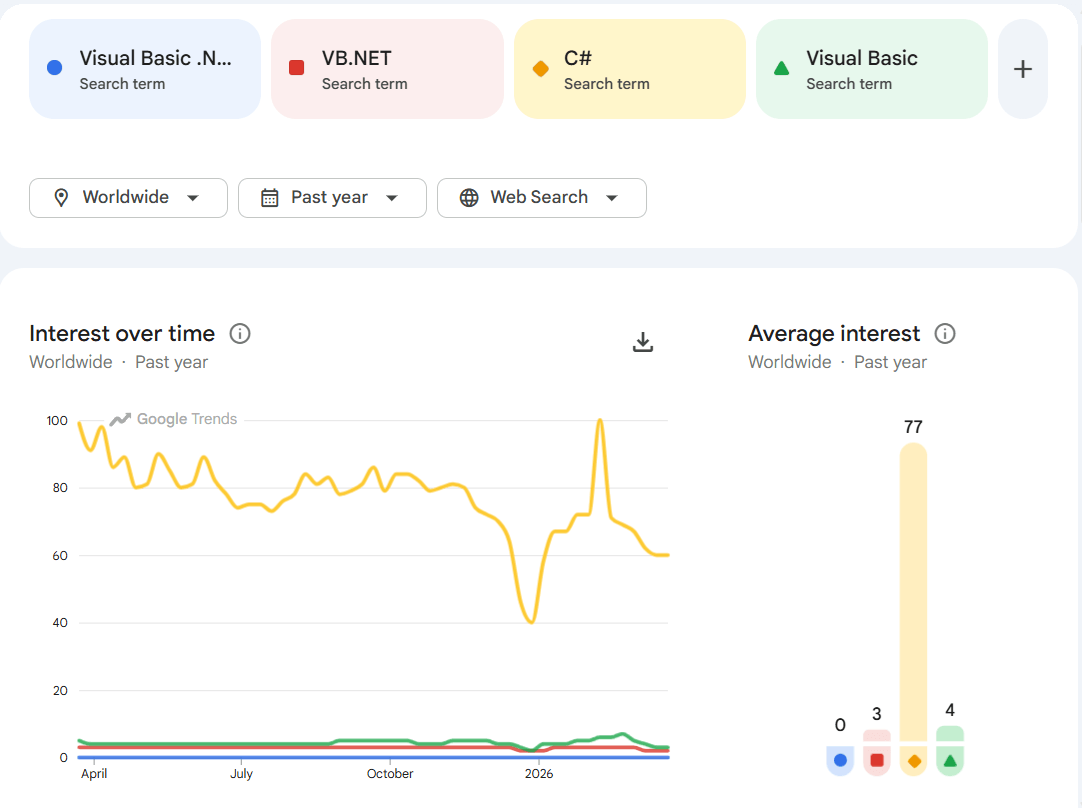
But Google Trends is not the full story. As a freelance .NET developer, I still receive regular VB.NET project requests. Looking at my incoming programming jobs by language over the past years, VB.NET accounts for a significant share of .NET-related work:
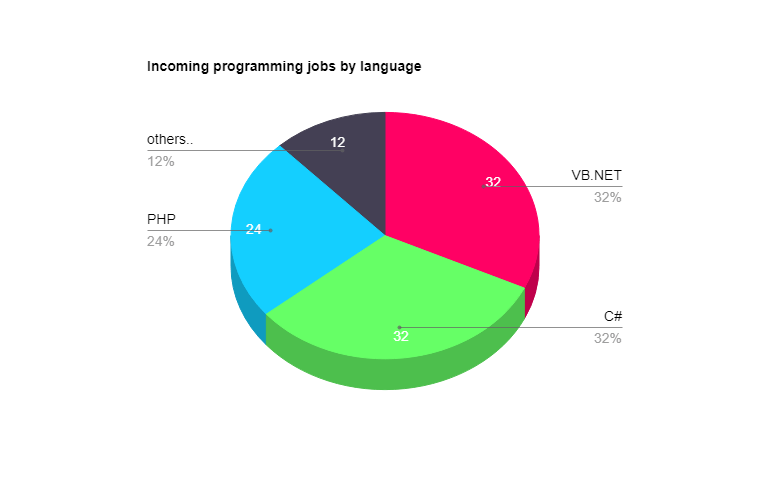
The requests are surprisingly balanced between VB.NET and C# in my niche. This does not mean VB.NET is thriving globally, but it shows that real demand still exists, especially for maintaining and extending legacy applications.
Who still uses VB.NET
After 17+ years in this field, working with YouTube subscribers, website visitors, and customers, I can give a fairly clear picture of who still writes VB.NET code:
- Hobbyists and self-taught developers: People who learned VB.NET years ago and build small tools for personal use or to automate their day jobs
- Companies with legacy codebases: Businesses running WinForms or WPF applications built 10-15 years ago that still work and generate revenue
- Automation and measurement projects: VB.NET is common in industrial automation, data logging, and measurement tools
- Excel/Office integration: VBA developers who stepped up to VB.NET for more complex tooling
Honestly, most VB.NET developers I encounter are 50+ years old and many operate at a hobbyist skill level. Clean code, unit testing, and SOLID principles are the exception, not the rule. This is not VB.NET’s fault as a language. It is capable of clean, professional code. But the community that remains tends to prioritize „it works“ over maintainability. If you want to write better code regardless of language, check out my Clean Code guide.
What VB.NET is still good for
Despite its declining trajectory, VB.NET has legitimate use cases:
- Learning programming: The English-like syntax makes it one of the most approachable languages for beginners.
If x > 5 Thenreads like a sentence. For someone who has never written code, this lowers the barrier significantly. - Maintaining existing applications: If you have a running WinForms app with 100k lines of VB.NET, rewriting it in C# just for the sake of it makes no business sense. Maintain it, extend it, and migrate incrementally if needed.
- Small internal tools: Quick automation tools, data converters, or reporting utilities where the developer already knows VB.NET.
- Prototyping: VB.NET’s WinForms designer is still one of the fastest ways to throw together a UI for testing an idea.
VB.NET is perfectly capable of professional work. For example, see how to properly use a VB.NET Dictionary or how to write text files in VB.NET.
Why you should learn C# instead
If you are starting fresh or considering your next step, the answer is C#. Not because VB.NET is bad, but because the ecosystem has moved on:
- Every new .NET feature targets C# first (and often only)
- Job market: C# job listings outnumber VB.NET listings by a factor of 20+
- Community and resources: Stack Overflow answers, tutorials, NuGet packages, and blog posts overwhelmingly target C#
- Cross-platform: .NET MAUI, Blazor, ASP.NET Minimal APIs are all C#-only
- Career growth: Knowing C# opens doors to web, mobile, cloud, and game development (Unity)
The good news: if you know VB.NET, learning C# is not that hard. The .NET framework is the same. The syntax is different, but the concepts (classes, events, LINQ, async/await) transfer directly. Many of the patterns you already know from VB.NET work identically. For example, event handling with AddHandler in VB.NET maps directly to C#’s += operator.
My personal take
I started programming with VB.NET when I was around 13 years old. I had tried C and C++ before and quit out of frustration. VB.NET’s approachable syntax got me through the door, and I never left the world of software development. Today I work primarily in C#, but VB.NET is still part of my regular toolkit.
I also think VB.NET gets unfair treatment. The language itself is not the problem. It supports clean code, SOLID principles, and proper architecture. The problem is that it attracts beginners who never progress beyond „it works“ code. That gives the language a bad reputation it does not fully deserve.
If someone asks me „Should I start with VB.NET or C#?“, my answer is always C#. But if someone asks „Is VB.NET dead?“, my honest answer is: it is slowly fading out, but it is not dead yet. And if learning VB.NET is what gets you into programming, then it served its purpose.
FAQ
Yes, VB.NET is still supported in .NET 8 and .NET 9 for bug fixes and compatibility. However, Microsoft will not add new language features. New frameworks like Blazor, MAUI, and Minimal APIs are C#-only.
C#, without question. Every new .NET feature targets C# first, the job market is 20x larger, and frameworks like Blazor and MAUI only work with C#. VB.NET is fine for maintaining existing apps, but not for starting fresh.
Yes. The .NET framework is the same underneath. Tools like the Telerik Code Converter can do a first pass, but complex projects need manual review. Many developers migrate incrementally, converting one module at a time while both languages coexist in the same solution.
Microsoft has committed to keeping VB.NET compiling and running on new .NET versions. Your existing code will not suddenly break. But you will miss out on new APIs and frameworks that are C#-only, which limits what you can build over time.
Yes, VB.NET’s English-like syntax makes it one of the easiest languages to start with. Code like If x > 5 Then reads like a sentence. But plan to move to C# once you understand the basics, as VB.NET offers limited career growth.
Wrapping up
Visual Basic .NET is not dead, but it is fading. Microsoft maintains it for compatibility, not for innovation. The community is shrinking, new frameworks skip it entirely, and the job market overwhelmingly favors C#. If you have existing VB.NET code, keep maintaining it. If you are starting fresh, go with C#. And if VB.NET is what got you into programming, be thankful for it and move forward. For hands-on VB.NET content, see the VB.NET Timer guide or the VB.NET List guide.